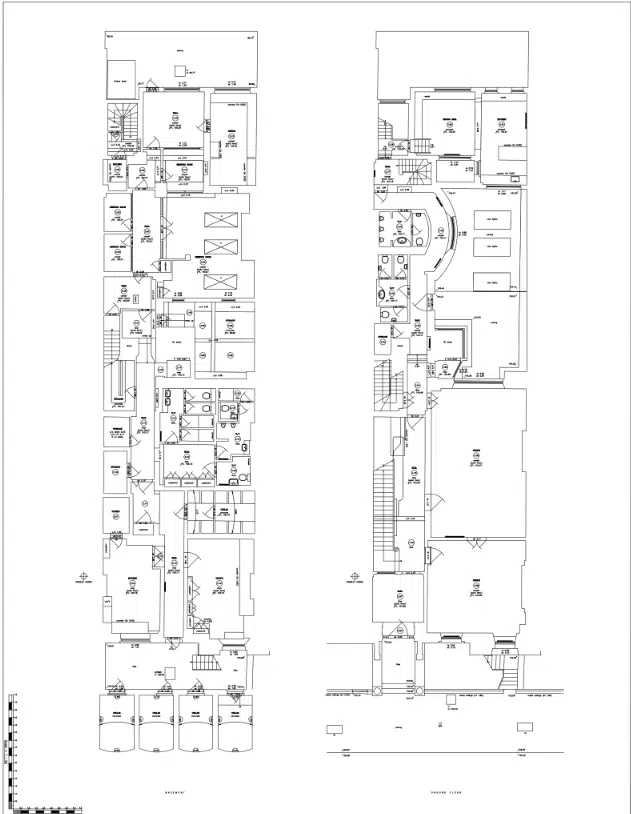
We will survey all accessible floors in the property and provide plans showing all visible walls, windows, doors, spot height levels, ceiling/roof heights, window sill/head heights.

Call 0333 335 5085 or send us a message
A measured building survey records the accurate dimensions, layout and structural features of an existing building, producing floor plans, elevations, sections and 3D models for planning, design and construction projects.
This type of measured survey provides the verified information and technical detail required for architectural design, technical coordination and property development. At XP Surveys, we deliver high-precision measured building surveys, as-built documentation and 3D laser scanning services across the UK, capturing complex structures with millimetre-level accuracy (±2mm).
Using advanced High-Definition Surveying (HDS), our scanners capture millions of data points per second to generate high-density point cloud information, recording a building’s geometry, structure and spatial layout in detail. This helps reduce project risk, minimise unnecessary return visits and provide reliable existing-building information for architectural and construction teams.
From residential properties and extensions to large commercial developments and industrial buildings, our digital capture workflow produces coordinated outputs including 2D CAD drawings and 3D Revit BIM models, supporting refurbishment projects, technical documentation and detailed GIA/NIA analysis.
This level of precision is particularly important during technical design coordination, where reliable survey information supports clash detection, spatial verification and project efficiency throughout the design and construction process. Whether working on constrained sites, complex refurbishments or multi-level industrial developments, our survey-grade deliverables provide a dependable foundation from the outset.

Our as-built surveys combine professional expertise with industry-leading laser scanning technology, including Trimble X7 and Leica RTC360 systems. We capture detailed existing-condition data across residential and commercial buildings, recording geometry, structural elements and spatial layouts with exceptional accuracy.
Watch how we capture structured data using high-precision laser scanning technology.
We use high-density point cloud capture to collect and structure building data into coordinated outputs for architectural and technical design workflows. All information is referenced and aligned to ensure consistency across plans, elevations and sections.
This allows architects to extract additional dimensions and details directly from the point cloud without requiring return site visits. The resulting drawings provide a verified representation of the building, enabling referenced design development and reducing the risk of discrepancies during technical coordination.
The as-built documentation can be tailored to suit different project requirements, depending on the level of detail needed and how the survey data will be used. Selecting the right survey type ensures architects, developers and contractors receive accurate existing-condition information that supports confident planning, design and construction decisions.
From basic floor plans through to detailed laser scanning and BIM-ready outputs, our building measured surveys provide flexible solutions for residential and commercial projects of all sizes.
| Measurement Types | Description | Use Case |
|---|---|---|
| Basic Floor Plan | Essential internal layouts showing wall positions, openings, room dimensions and key structural elements. | Ideal for renovations, layouts and early design stages. |
| Elevational | Detailed measurements of building façades, including windows, doors, rooflines and architectural features. | Commonly used for planning applications and façade works. |
| Internal and External Elevation | Comprehensive documentation of both exterior surfaces and internal structural features, such as beams and columns. | Suitable for refurbishments and heritage projects. |
| Detailed Data Survey | Enhanced survey detail including fixtures, fittings and internal building elements where required. | Best for complex refurbishments or technical design stages. |
| 3D Laser Scanning | High-density point cloud capture used to create precise 3D models and BIM deliverables. | Ideal for complex structures and high-accuracy projects. |
| External Site & Context Surveys | Mapping of surrounding land and external features to complement building survey data. | Used when extensions or landscape changes are involved. |
As-built drawings provide architects, engineers and planners with the information required to move projects forward with confidence. The level of detail is tailored to suit each project, ensuring coordinated survey information throughout the design and construction process.
Fast laser scan surveys provide architects with dependable existing-building information from the outset. Using advanced laser scanning and BIM-ready workflows, we capture high-density point cloud information that integrates seamlessly into Revit and CAD environments — helping design teams save time, reduce risk and maintain consistency throughout the project lifecycle.
Architects, developers and contractors rely on measured building survey information to support confident design and construction decisions. Incomplete or outdated existing-condition drawings can lead to delays, coordination issues and unnecessary project costs.
Every survey is delivered in the formats your team needs — including 2D CAD drawings in AutoCAD (.dwg), 3D Revit BIM models, ArchiCAD-compatible files and raw point cloud data (.rcp/.e57). Outputs integrate directly into existing architectural and construction workflows without additional processing.
This allows architects, engineers and contractors to work from coordinated building information throughout design development, technical coordination and project delivery.

CAD-ready outputs can be delivered in as little as 3 days. We use industry-leading equipment including the Trimble X7 and Leica RTC360 to capture detailed building information to ±2mm accuracy, with clear fixed pricing and no hidden fees.
Trusted by architects, developers and property professionals across the UK. View our survey equipment or use the quote tool to get pricing for your project.

A measured building survey is usually required when accurate existing-building drawings are needed for planning, refurbishment, extensions, structural alterations or ongoing building management.
CAD/BIM deliverables are required at various stages of property development and management to ensure accurate planning and execution. The specific instances when an existing measured survey is required to improve accuracy include:
As-built precise building measurements are vital throughout the lifecycle of a property, from initial planning to ongoing maintenance, providing accurate data that supports informed decision-making and project success.
The cost depends on property size, complexity, access, level of detail and required outputs such as CAD drawings or BIM models.
Measured survey costs vary significantly depending on project scope — a standard 2–3 bed house costs far less than a multi-storey commercial building.
At XP Surveys, pricing is transparent and straightforward, with no hidden fees or vague estimates. Final costs are based on the scale of the property, accessibility, required level of detail and the type of deliverables needed for your project.
Here’s what you can expect:
| Property Type | Example Cost (From) |
| 2–3 Bed House (Standard) | £250 – £500 + VAT |
| 4–5 Bed House (Incl. Loft/Sections) | £600 – £2,100 + VAT |
| Large Properties/Commercial | Individually quoted based on scope |
These estimates cover on-site data capture and delivery of 2D CAD-ready drawings. All pricing includes measurements to within ±2mm accuracy.
Your final cost depends on several key factors:
Tip: Clearly define your scope upfront to avoid extra site visits and unexpected charges.
A measured building survey provides essential documentation and survey information for architectural, engineering and construction projects. Our deliverables are tailored to your project, ensuring you receive accurate drawings and data aligned with your design and planning requirements. Here’s what you can expect:
Deliverables can be supplied in commonly used CAD and digital formats to support professional design workflows. Output type and format are agreed in advance to ensure compatibility with your team’s requirements. We provide data in the format your team needs for immediate use:
Survey Control: Every measured survey is referenced to an established control framework, ensuring that multi-storey buildings align perfectly across all drawings.
2D CAD drawings generated from laser scan data in accordance with RICS guidance. Deliverables can include room dimensions, structural features, openings and internal fittings as required, typically produced at scales ranging from 1:50 to 1:200.


A measured survey is the professional process of recording the dimensions, layout and structural features of an existing building or site. The result is a set of verified drawings — typically floor plans, elevations and sections — used to support planning applications, refurbishments, extensions and construction projects.
Measured building surveys range from basic floor plans to advanced 3D laser scanning and BIM-ready outputs, depending on project requirements. They provide architects, designers and construction teams with reliable existing-condition information before design work begins.
3D laser scanning allows surveyors to capture complex buildings and structural details quickly and efficiently. The process reduces the need for repeat site visits while supporting accurate floor plans, elevations, sections and technical documentation.
Laser scanning also creates detailed point cloud information that can support CAD drawings, BIM workflows and refurbishment projects. Learn more about our laser scanning services.
Survey times depend on the size, complexity and level of detail required for the project. Smaller residential properties may take a few hours, while larger buildings or surveys including elevations, sections and laser scanning can take several days.
A point cloud is a digital collection of measured points captured using 3D laser scanning technology, creating a detailed representation of a building or site.
Point cloud information can be used to support CAD drawings, BIM modelling and technical coordination workflows. Explore our point cloud survey services.
We use a range of professional equipment to capture survey information, including 3D laser scanners, GPS equipment and traditional measuring tools. XP Surveys uses state-of-the-art equipment to deliver coordinated 2D CAD drawings and BIM-ready outputs.
The measured survey process varies depending on the project scope, but typically includes recording internal and external dimensions, structural features and relevant site elements required for design and construction workflows.
Our surveyors are trained to deliver the level of detail and output required for residential, commercial and industrial projects.
Scan to BIM is the process of converting 3D laser scan information into an intelligent BIM model for design, coordination and construction workflows.
Using point cloud information, BIM models can be created in platforms such as Revit to support refurbishment, planning and technical coordination. Learn more about our Scan to BIM services.
Cracks in heritage or listed buildings should always be assessed carefully, as traditional materials such as brick, stone, timber and lime mortar respond differently to moisture, settlement and structural movement.
Measured surveys create detailed floor plans, elevations and sections that architects, engineers and conservation specialists can use to assess structural movement and investigate potential causes of cracking.
For historic properties where original drawings are unavailable or outdated, measured surveys provide valuable information for repair planning, refurbishment and conservation work.
Working on a project in London? Explore our Measured Building Survey London service, supporting heritage properties, commercial refurbishments and residential developments across all 32 boroughs.
We’re looking forward to hearing from you and helping you achieve the best results from your measured survey.
We work all over the United Kingdom. Get an instant online quote at the best price — get your property’s precise data for projects nationwide. For architectural projects requiring detailed as-built drawings, view our instant quote calculator.


We will survey all accessible floors in the property and provide plans showing all visible walls, windows, doors, spot height levels, ceiling/roof heights, window sill/head heights.

We will survey all accessible and visible sides of the property and provide elevation drawings showing the building outline, ridge/eaves heights, all external distinguishing elements such as windows, doors, rainwater pipes and other detailing. We will also include the outline of buildings within 3m of the host building.

Provided where our equipment has full visibility of the roof lines from ground level, we will note any estimated roof details on our drawings.

These are 'cut-through' cross-sectional drawings showing wall and floor details.
Select a topographical survey level to find out more.

Will include the visible boundary outline only together with immediate ground levels around any buildings, and visible drainage cover location/levels.

This topo will include the visible boundary outline, all key features and immediate ground levels within 3m of any buildings, and visible drainage cover location/levels.

Will include boundaries (including type and heights), building OUTLINES, adjoining buildings, trees, hardstanding, walls, fences, hedges, flowerbeds, kerblines, verges, manhole / service covers (including cover level), etc. plus all other visible salient features of the area.
We use Area data from your property's EPC certificate and the UK Ordnance Survey database to calculate your quote estimate. If there is not enough data in the UK database we cannot provide an instant quote, but one of our team will be able to provide a formal written quote by email within 48 working hours. If the database holds incorrect data on your property you will still be provided an estimate, but our fee is subject to change to suit the actual size of your property
Your chosen outputs:
"I have found incredible flexibility and helpfulness in the XP Surveys team. In my last 10 professional years, I have rarely found a business, surveyors or otherwise, to be as useful, approachable and competitive as them. It helps provide confidence to myself and my clients alike."

A member of the XP Surveys team will be in touch shortly
Or call 0333 335 5085
Or call 0333 335 5085
Or call 0333 335 5085