We will survey all accessible floors in the property and provide plans showing all visible walls, windows, doors, spot height levels, ceiling/roof heights, window sill/head heights.

Call 0333 335 5085 or send us a message
Rather than delivering generic drawings or unstructured point cloud data, our outputs are configured for practical use within Revit, AutoCAD and SketchUp workflows. This allows architects, designers and consultants to begin working immediately without extensive redrawing, reformatting or manual coordination. Whether supporting residential extensions, commercial refurbishments, heritage projects or multidisciplinary developments, our approach focuses on producing dependable digital information aligned with the way modern architectural teams operate. 
Architectural survey requirements change significantly throughout the design process. We structure deliverables around the relevant RIBA stage, ensuring the level of information remains appropriate to the scope and technical requirements of the project.
At the feasibility and briefing stage, architects require enough information to assess constraints, understand the building layout and review the relationship between the structure and its surrounding site context.
Typical outputs may include:
This level of information supports feasibility assessments, early planning discussions and client briefing without producing unnecessary detail too early in the project lifecycle.
As design proposals develop, accurate geometry and coordinated building information become increasingly important for testing layouts, extensions and spatial relationships.
At this stage, we commonly provide:
All outputs remain coordinated across plans, sections and elevations to maintain consistency throughout concept-stage design work.
Technical coordination requires a higher level of accuracy, structure and interoperability between consultants, contractors and design teams.
Our Stage 3–4 deliverables can include:
Structured survey data provides architects and consultants with a dependable digital foundation for technical development, planning coordination and building control documentation.


We provide structured Revit-compatible outputs designed to integrate directly into live BIM environments. Linked point cloud reference files allow architects and consultants to extract additional dimensions and verify building geometry throughout the project lifecycle without requiring repeat site visits.
Models can be aligned using shared coordinates, project base points and agreed control systems to support coordinated consultant workflows across architectural, structural and MEP disciplines.
CAD drawings are supplied as layered .dwg files configured to match office standards, including custom layer naming, line weights and title block formats. This ensures outputs slot directly into existing drawing packages without manual reformatting.
Where concept-stage visualisation or early massing studies are required, survey data can be translated into lightweight SketchUp models. This allows design teams to move quickly from site capture into design exploration without waiting for full BIM production.
CAD outputs are configured using agreed layering structures and drawing standards, helping architectural teams integrate survey drawings directly into existing project packages.
This may include:
By aligning outputs with office standards from the outset, architects avoid time-consuming reorganisation and reformatting before design work begins.
For concept design and visualisation stages, lightweight SketchUp-compatible models can be produced to support massing studies, spatial testing and early-stage design development without the complexity of a full BIM workflow.

Generic survey drawings often require extensive reorganisation before they can be used within a professional design package. Our workflow is designed to eliminate that process.
Before production begins, we coordinate:
The result is survey information that integrates directly into live architectural workflows with minimal additional processing.


Heritage and conservation-led projects often require a significantly greater level of detail and documentation than standard refurbishment or extension schemes.
Our survey workflows support projects involving:
Detailed existing-condition information helps architects coordinate sensitive design proposals while supporting planning authorities, conservation officers and heritage consultants with reliable reference material throughout the approval process.
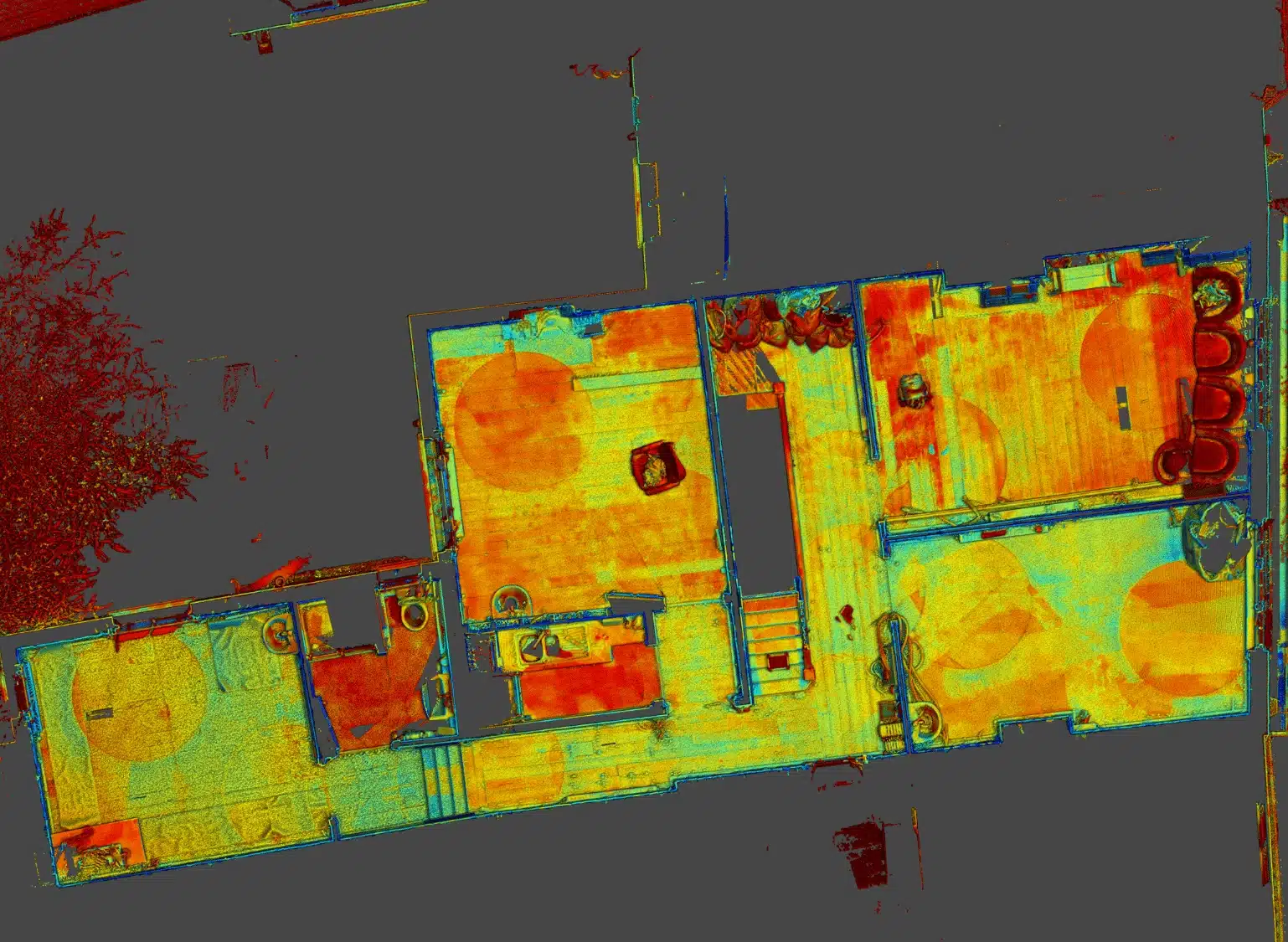
Architectural projects increasingly rely on coordinated information shared across multiple disciplines. Structured survey data supports collaboration between:
By working from coordinated existing-condition information, design teams can reduce inconsistencies, improve spatial coordination and minimise errors during technical development and construction phases.

We work exclusively with professional design teams, which means our survey workflows are built around the way architectural practices actually operate — from CAD standards and BIM coordination through to planning submissions and heritage documentation.
Our survey services for architects are built on a structured measured building survey methodology, delivering dependable existing-condition data throughout planning, technical design and construction coordination stages.
For projects requiring 3D Revit models from scan data, explore our Scan-to-BIM service. For external site and terrain information alongside building data, we also provide integrated topographical surveys.
Contact XP Surveys to discuss your project requirements, required outputs and timescales. Get in touch here or call 0333 335 5085.
For projects in London, visit our Measured Building Survey London page.
Yes. We can configure all CAD outputs to BS1192 or ISO 19650 layer naming conventions, or match your practice’s bespoke office standard. Layer structures, line weights, annotation styles and title block formats are agreed upon before production begins, so drawings integrate directly into your project package without reformatting.
Our surveys are carried out using Trimble X7 and Leica RTC360 laser scanners, achieving ±2mm positional accuracy. This is suitable for all RIBA Stage 2–4 design and technical coordination work, including listed building and heritage projects where high precision is essential.
Yes. We align all Revit outputs to your project base point, shared coordinates and agreed control system. Models are delivered structured to your template requirements so they link directly into your live BIM environment without additional setup.
Yes. Registered point cloud data can be delivered alongside or separately from CAD and Revit outputs. Point clouds are linked into Revit as reference files, allowing architects and consultants to extract additional dimensions and verify geometry throughout the project without repeat site visits.
Standard turnaround for CAD-ready measured survey drawings is 3–5 working days from survey completion. Expedited 3-day turnaround is available on request depending on project size and scope. Revit models and Scan-to-BIM deliverables are typically 5–10 working days.
Yes. We have extensive experience surveying Grade I and Grade II listed buildings, properties within conservation areas and historic structures requiring detailed existing-condition documentation. Our outputs support Listed Building Consent applications, heritage impact assessments and pre-restoration records.
Contact Us now for a free consultation and receive a detailed proposal outlining costs, timelines, and survey specifications. If you are based in south contact our London architectural surveys


We will survey all accessible floors in the property and provide plans showing all visible walls, windows, doors, spot height levels, ceiling/roof heights, window sill/head heights.

We will survey all accessible and visible sides of the property and provide elevation drawings showing the building outline, ridge/eaves heights, all external distinguishing elements such as windows, doors, rainwater pipes and other detailing. We will also include the outline of buildings within 3m of the host building.

Provided where our equipment has full visibility of the roof lines from ground level, we will note any estimated roof details on our drawings.

These are 'cut-through' cross-sectional drawings showing wall and floor details.
Select a topographical survey level to find out more.

Will include the visible boundary outline only together with immediate ground levels around any buildings, and visible drainage cover location/levels.

This topo will include the visible boundary outline, all key features and immediate ground levels within 3m of any buildings, and visible drainage cover location/levels.

Will include boundaries (including type and heights), building OUTLINES, adjoining buildings, trees / groups of trees (including trunk diameter, spread, height) (any diameter above 150mm would be shown), hardstanding, walls, fences, hedges, flowerbeds, kerblines, verges, manhole / service covers (including cover level), etc. plus all other visible salient features of the area.
We use Area data from your property's EPC certificate and the UK Ordnance Survey database to calculate your quote estimate. If there is not enough data in the UK database we cannot provide an instant quote, but one of our team will be able to provide a formal written quote by email within 48 working hours. If the database holds incorrect data on your property you will still be provided an estimate, but our fee is subject to change to suit the actual size of your property
Your chosen outputs:
"I have found incredible flexibility and helpfulness in the XP Surveys team. In my last 10 professional years, I have rarely found a business, surveyors or otherwise, to be as useful, approachable and competitive as them. It helps provide confidence to myself and my clients alike."

A member of the XP Surveys team will be in touch shortly
Or call 0333 335 5085
Or call 0333 335 5085
Or call 0333 335 5085